
Compounding Collectibility
There are many single factors that make Pokemon cards collectible. Let's examine why some types of cards set themselves apart from the rest.

In a booming market, almost everyone is a winner and even the losing plays get bailed out. I’ve never been a fan of the noise in the space, especially when the discourse is reduced to a number - price, amount sold, how to make x, I spent x, etc. As a business, I have to be realistic because I am also a beneficiary. However, I have always been in the pursuit of staying rooted in a collecting ethos.
I started this wanting to curate a selection that the hobbyist vintage and vinyl collector version of me would also be in to - Pokemon cards that make me go “I’ve been looking for that card for so long” and “hey that’s a little different, what else can I find?”. Curation isn’t only rooted in the obscure niche - many times it’s comprised of what we’re familiar with but with a few key differentiating traits mixed in.
Popular Characters
Pikachu, Charizard, Umbreon, Rayquaza, and Mew are likely Pokemon’s version of Jordan, Lebron, Steph, Shaq, and Kobe. We remember these NBA greats because of their impact on the game and specific moments in our lives, similar to how iconic Pokemon have sustained their impact on the franchise across generations.


Pokemon card collectors are invested in these characters and the breadth of cards they’re depicted on, so whenever there’s a new release of a popular Pokemon’s card, people pay attention. Even slightly less popular Pokemon such as Gengar and Lugia have the universal appeal to carry specific TCG sets. Popular characters are the lowest barrier to entry because it gives collecting the allure, accessibility, and sentimentality through Pokemon’s fan favorites.
Vintage
Things reach vintage status when they are between 20 and 25 years old. In Pokemon terms, we’ve generally seen the WOTC era for English, and Old Back era in Japanese as vintage. But now, I don’t think it would be controversial to consider the e-series eras from 2002-2006 as vintage.
Semantics aside, vintage -anything- is cool. I myself am a sucker for vintage clothes, old/limited pressings of vinyl, and of course, vintage Pokemon Cards. Vintage things quite literally have years of history, aesthetic designs specific to its time, and sentimentality to the people who have owned them over time. For example, vintage clothes develop a patina or were made with a specific cut, whereas vintage Pokemon cards were worn down after being played in decks, traded amongst each other, and stored in ways we wouldn’t do so today.


Vintage opens up a deep catalogue of Pokemon’s history, as well as different types of chases. Whether it’s completing a specific collection regardless of condition, or chasing gem mint condition itself, vintage opens up 30+ years of collectability.
Liquidity
Popularity and achieving vintage status are two different pillars that need each other in order to be taken seriously as an alternative asset. In recent years, Pokemon cards have achieved varying levels of liquidity. Anyone can:
Walk into a card show and sell their cards to a vendor
Sell themselves via eBay
Consign to an auction house
All you need is a phone and an internet connection to look up when a card last sold and what it sold for. Some cards are more liquid than others and can’t be kept in stock. However, it’s important to know that just because a card is old or shows a popular character doesn’t mean it is liquid.
It can’t be denied that the lines between collectability, business, and financial assets are more blurred than ever. Personal collections can be sold or traded in pursuit of a larger collection purchase, “grail” cards are sold to fund real life events, and Pokemon card hobbies can become legitimate businesses that change lives.
Regardless of how people feel about this, liquidity is now an undeniable factor when it comes to a collection purchase because of the established value that comes with it.
Rarity
Rarity in any form is an obvious barrier to entry that comes with a justified price premium. There are two different concepts that roll up to its core definition.
Print Rarity
Limited production. Some cards have known print runs of 5000, 1000, 500, and even as little as 100 and below. Some have unknown print runs. Such quantities typically signify a specific event/promotion. Single quantities are typically trophies.
Condition Rarity
The difficulty to obtain an as high as possible condition rarity, such as a PSA 10 and in some extreme cases, a PSA 9. Certain cards may have suffered from poor print quality, been in conditions where they were easily damaged, or are now difficult to find in mint condition. This is often reflected in population reports where the 10 ratio is low, relative to the amount of 9s and 8s that exist.
Is “Low Pop” automatically condition rarity?
Some sellers will point to their PSA 3 and call it low pop. Low grades are not a sign of condition rarity because cards lower in the condition spectrum are sent in for grading less often than their mintier counterparts. Also, any card can be made to be in worse condition and not the other way around.
Under-graded cards
Cards with a low population of 10s also are not an immediate indicator of condition rarity. Bulk commons, energies, and many reverse holos are cards that most people don’t bother grading. So when a pop report shows that a uncommon, non-holo card in PSA 10 has a pop of 2, stop to consider how many more of them are forgotten in bulk boxes - the type of cards that are given away for free.
Compounding Rarity
Cards with at least one of print rarity or condition rarity are noteworthy enough from a collecting standpoint. It’s not an “either/or” thing as well. Some cards have both. Imagine having to find a legitimately rare card AND having to find it in as mint condition as possible.
Language Exclusivity
Cards that were only released in a specific language. This isn’t necessarily Pokemon coming out and saying “these cards will ONLY be in _____ language”. Certain cards, typically promos or event cards, come out and over time the community notices and establishes that we won’t be getting the card in another language.
The barrier to entry with language exclusivity is its adjacency to the next section, promos. You have to be plugged into the space to know what was language exclusive in the past and what exclusives are in the pipeline. It wasn’t until fairly recently that English and Japanese cards were the only languages that mattered. But now, a variety of language exclusive cards are released and collected.


Promos
If main set cards were akin to obtaining the gym badges and fighting the Elite Four in across each era of video games, then collecting promo cards are like chasing after legendaries and shiny Pokemon - The first few may come easy, but the rest can become a grind.


As mentioned, promos are often language exclusive and bound to a specific event. This means that most people would have to turn to the second hand market in order to obtain past and present promos. Buying the card isn’t the only barrier to entry here - it’s knowledge and curiosity to explore past the surface level of main sets and repacks.
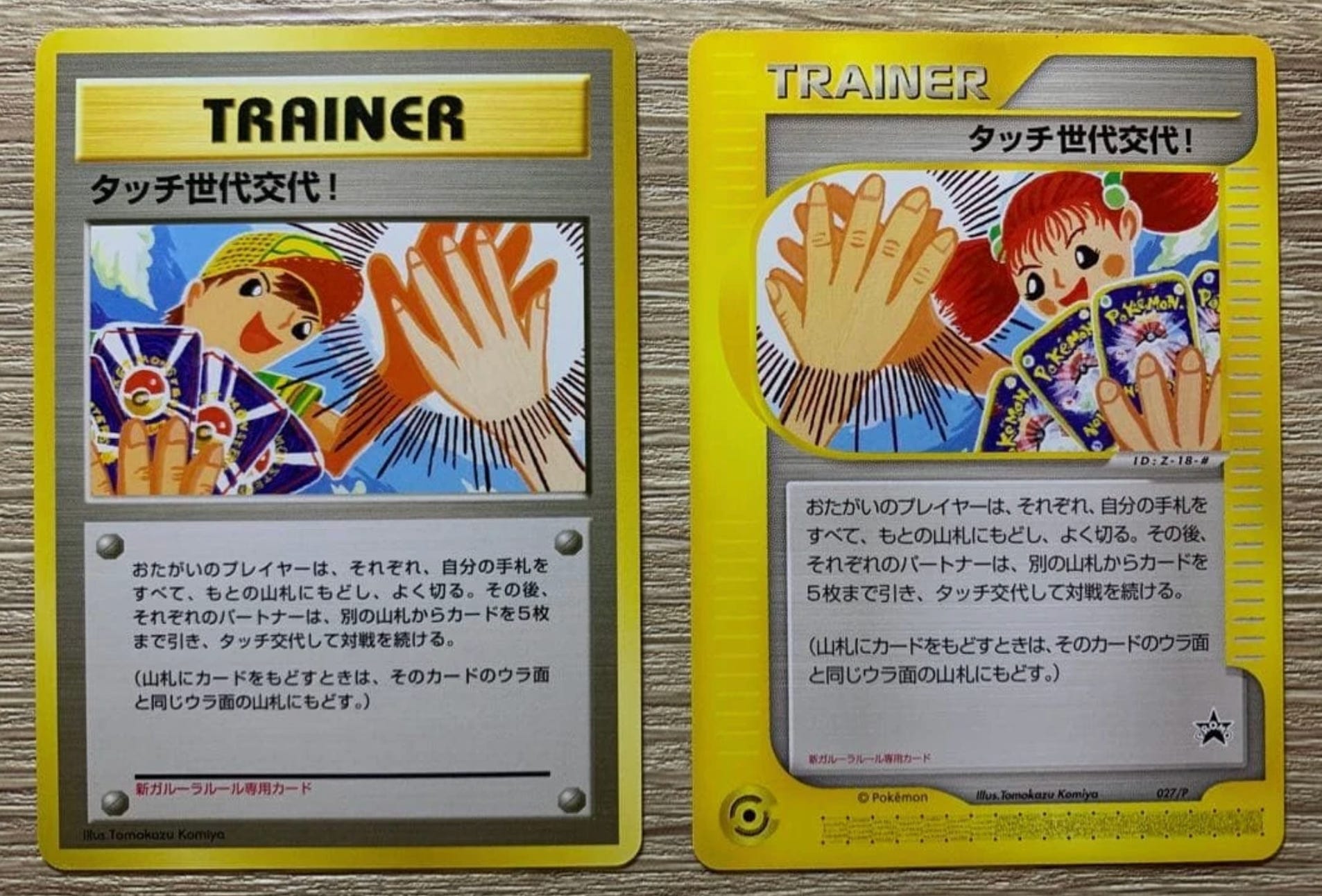
Promos represent moments in time - ask most collectors and they will likely have a promo that comes to mind that made them go “that card is different”. Collecting as many promos as possible is like chasing every single shiny in the video game - technically possible.
Thematic Identity
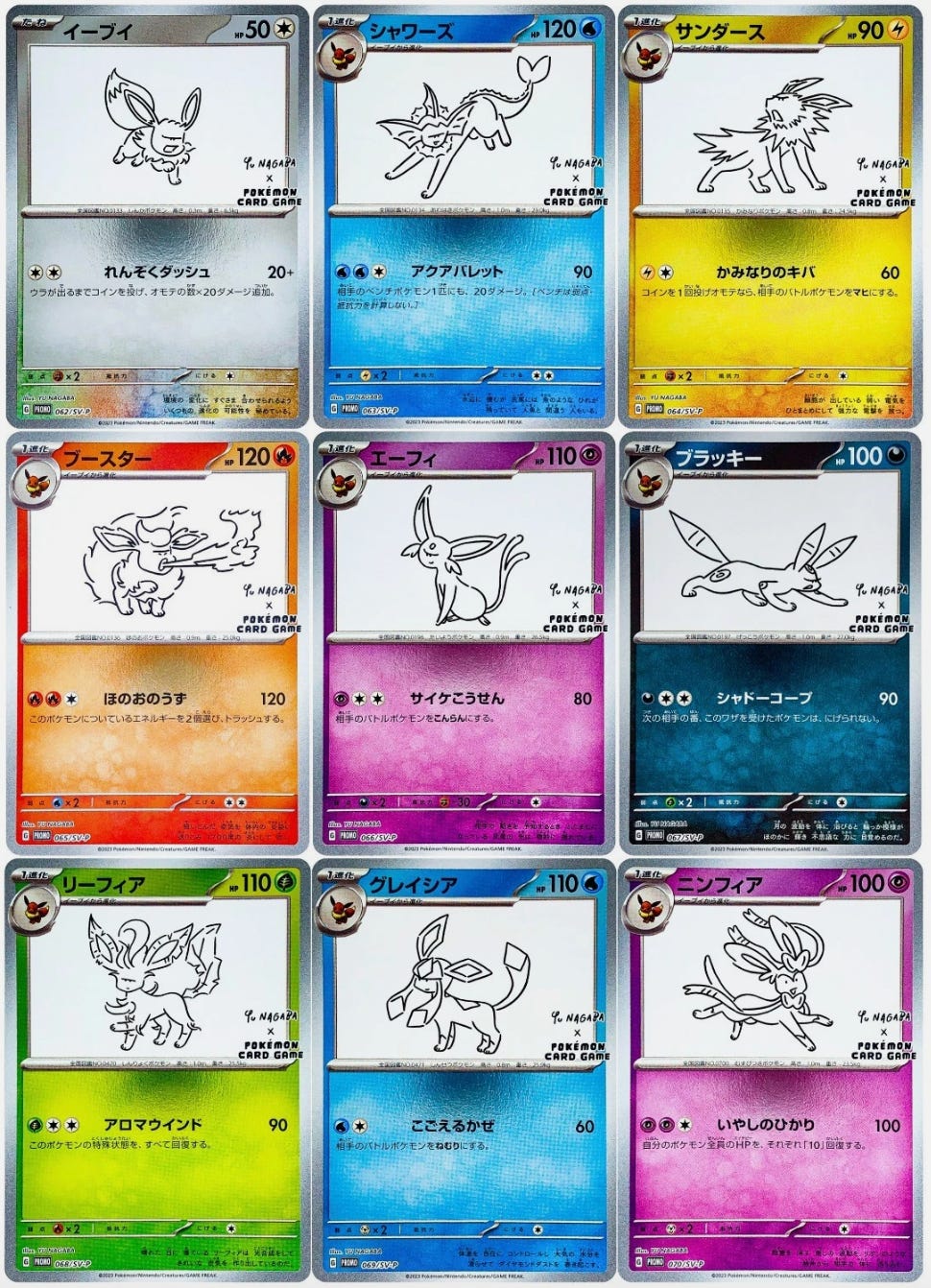
If you’ve ever thought to yourself “Well now that I’ve bought X, I can’t just stop there” when buying a card, that’s what thematic identity is. Many cards have companion cards where the artwork is either connected or the set it belongs to is so cohesive that you can’t help but track down other cards.
This could be as simple as Art Rares that have connecting artwork, Pokemon with companion Pokemon such as Latios/Latias, Plusle/Minun, or the Eeveelutions. Or, it could become a collecting journey that feels like a mission - think 1st Edition Base Set, Scream Promos, Gold Stars, Masaki promos, etc.
Historical Significance
If a timeline had to be made over the course of Pokemon’s 30 year history, which cards would be mentioned? This varies based on which lens it is seen through (competitive play, collecting, etc), but from a collectibility perspective, cards that fall under this category don’t need much explaining.


Compounding Collectibility
You’ve likely noticed by now that many of the examples pictured throughout could also be used as an example for another section. The cards that become collection staples and sought after are the ones with more than one trait, though not all of them are needed - that wouldn’t be realistic. In my opinion, many “grails” of the space have most of these traits but not all of them.
For example, Korean Ditto is more than just a Korean exclusive card. It features popular characters, it’s a promo, and it’s very liquid. However, it’s not rare, it’s not difficult to grade, and too recent to consider its historical impact - not bad things. It’s just accessible and easy to understand why it’s a good card.
Glossy Ivy Pikachu on the other hand, is not a language exclusive card, but it’s a Pikachu (popular), the first card to be released (historical), one of the most difficult cards to grade, and a promo. However, it didn’t reach premium pricing until recently. One could make the argument that it is still undervalued at its current prices.
Exposure (or lack of) is an unmentioned nuance that can keep a card like this in the background whereas exposure can bring otherwise run of the mill cards demand that creates liquidity. These are the layers and levels that keep Pokemon cards interesting.
When you start identifying cards with converging traits rather than its +/-% price change or whatever it last sold for, you are building knowledge capital. And when the collectibility knowledge muscle is trained, it enables a more discerning taste. That’s when the collecting journey really gets started.